


Page 164 - 56-1 One Report 2022 EN
P. 164
Part 2 Corporate Governance


               The committee of the Management that reports to the Audit and Risk Committee is:

               Risk Management Committee
               The Risk Management Committee shall be comprised of not less than 7 members and not more than 15 members
               in order to be able to oversee and manage the overall risk exposure in the areas of the Financial, Commercial,
               Legal, Internal control, Compliance, Corporate Governance, Operation, Information technology, Sustainability,
               Industry, and others if applicable. A committee member must be knowledgeable, capable, honest, and dedicate
               adequate time to their position as a committee member in order to drive the Company’s risk management goals in
               alignment with the Company’s business direction, by directly reporting to the Audit and Risk Committee, and the
               Board of Directors respectively.

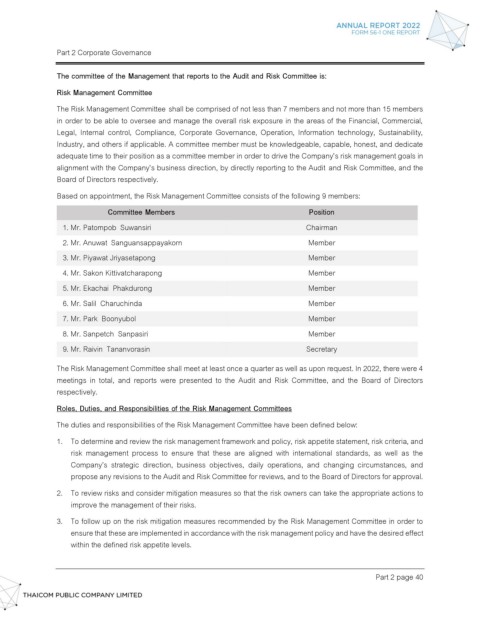
               Based on appointment, the Risk Management Committee consists of the following 9 members:

                            Committee Members                                   Position
                 1. Mr. Patompob  Suwansiri                                    Chairman

                 2. Mr. Anuwat  Sanguansappayakorn                              Member
                 3. Mr. Piyawat Jriyasetapong                                   Member
                 4. Mr. Sakon Kittivatcharapong                                 Member

                 5. Mr. Ekachai  Phakdurong                                     Member
                 6. Mr. Salil  Charuchinda                                      Member

                 7. Mr. Park  Boonyubol                                         Member
                 8. Mr. Sanpetch  Sanpasiri                                     Member
                 9. Mr. Raivin  Tananvorasin                                   Secretary


               The Risk Management Committee shall meet at least once a quarter as well as upon request. In 2022, there were 4
               meetings in total, and reports were presented to the Audit and Risk Committee, and the Board of Directors
               respectively.

               Roles, Duties, and Responsibilities of the Risk Management Committees

               The duties and responsibilities of the Risk Management Committee have been defined below:
               1.  To determine and review the risk management framework and policy, risk appetite statement, risk criteria, and
                   risk  management process to  ensure that  these  are  aligned with  international standards, as  well  as  the
                   Company’s  strategic  direction, business  objectives,  daily  operations, and  changing  circumstances, and
                   propose any revisions to the Audit and Risk Committee for reviews, and to the Board of Directors for approval.

               2.  To review risks and consider mitigation measures so that the risk owners can take the appropriate actions to
                   improve the management of their risks.

               3.  To follow up on the risk mitigation measures recommended by the Risk Management Committee in order to
                   ensure that these are implemented in accordance with the risk management policy and have the desired effect
                   within the defined risk appetite levels.


                                                                                                      Part 2 page 40

